OpenSteamTool Internals: How Lua Metadata Drives Steam Fake Library Entries
Contents
This is a source-reading and client trust-boundary analysis. It does not publish real depot keys, access tokens, tickets, or reusable manifest lists, and it is not a guide for bypassing ownership checks. All Lua snippets below are structural examples.
Abstract
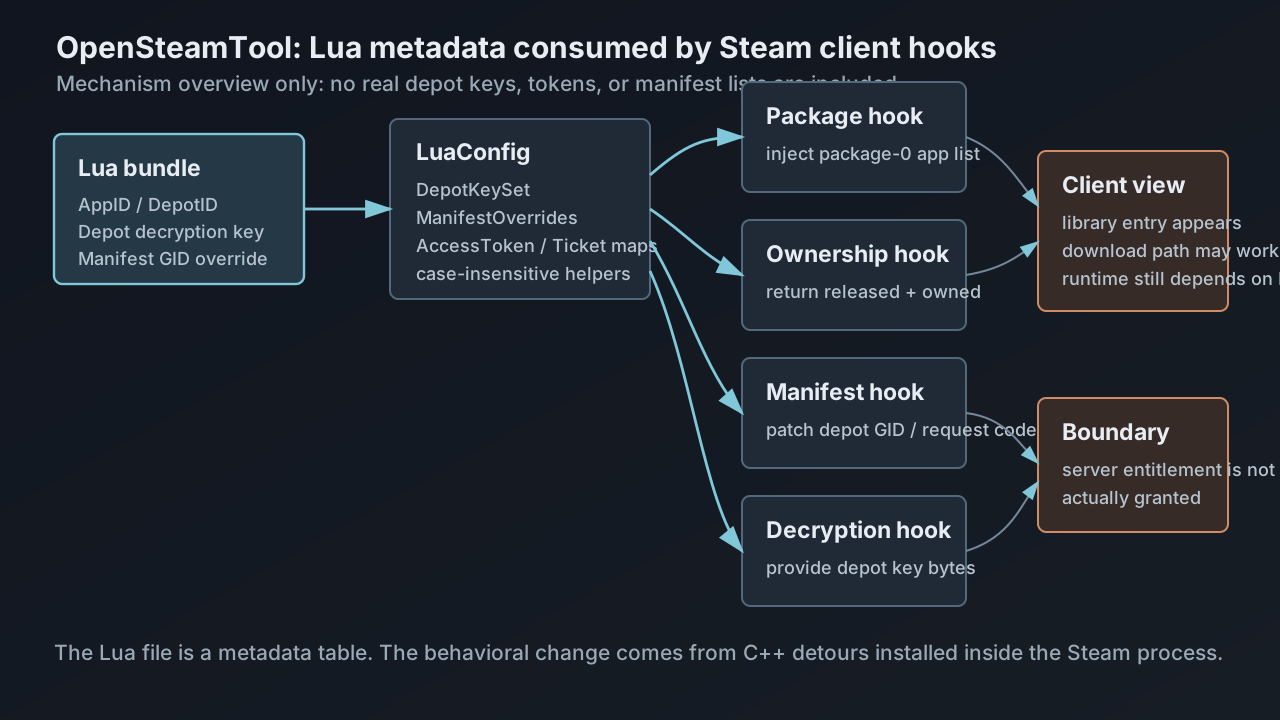
OpenSteamTool is best understood as a configuration-driven client-state rewriting system. Lua files declare target AppIDs or DepotIDs, depot decryption keys, and manifest GID overrides. The C++ DLL then enters steam.exe and uses those declarations to patch Steam client’s package, ownership, manifest, depot-key, IPC, and protobuf network paths.
The analyzed 1086940.lua file is not an algorithm. It is a content metadata table. It has 108 lines, 55 addappid calls, 54 unique IDs, 53 setManifestid calls, and 54 strings shaped like 64-character depot keys. The first ID, 1086940, is publicly associated with Baldur’s Gate 3 on the Steam store.
The crucial distinction is this:
OpenSteamTool can rewrite local client facts.
It cannot create a real server-side Steam entitlement.
Method and Evidence
This analysis cross-checks three sources.
The first source is the OpenSteamTool codebase:
| Area | File | Role |
|---|---|---|
| Loader | src/dllmain.cpp | Loads diversion.dll, parses Lua, installs hooks |
| Lua runtime | src/Utils/LuaConfig.cpp | Defines addappid, setManifestid, ticket helpers, HTTP helpers |
| Hot reload | src/Utils/FileWatcher.cpp | Parses newly added Lua files and refreshes licenses |
| Package and ownership | src/Hook/Hooks_Package.cpp | Injects app IDs into package 0 and spoofs ownership |
| Manifest | src/Hook/Hooks_Manifest.cpp | Replaces depot manifest GIDs and fetches manifest request codes |
| Depot key | src/Hook/Hooks_Decryption.cpp | Supplies depot decryption key bytes |
| IPC | src/Hook/Hooks_IPC*.cpp | Patches selected Steam API responses |
| Network packets | src/Hook/Hooks_NetPacket.cpp | Rewrites selected protobuf requests and responses |
| Structures | src/Steam/Structs.h | Defines local views of Valve internal structures |
The second source is the project README, which explicitly lists unowned-game unlocks, DLC unlocks, Lua-loaded depot decryption keys, manifest request-code providers, access token support, and ticket support.
The third source is public Steamworks documentation. Steamworks describes depots as logical file groups delivered to customers, build manifests as file and metadata lists for depot builds, and authentication APIs as mechanisms for user identity and application ownership validation.
Client-Side Scope
The phrase “fake library entry” should not be read as “the Steam account now owns the game.” The real entitlement record is server-side. OpenSteamTool operates after Steam client has turned server and local metadata into in-memory structures.
The practical target is narrower:
Make the local Steam client enter the same code path it would use
for an owned app, without changing Valve's server-side entitlement state.
That local illusion may affect the library UI, install button, depot selection, download flow, and some Steam API calls. It does not necessarily survive game backend checks, anti-cheat, Denuvo, encrypted app tickets, cloud permissions, multiplayer services, or server-side account checks.
Steam Content Model
An AppID identifies a Steam application: a game, DLC, tool, demo, test app, or related object. 1086940 is the public Steam AppID for Baldur’s Gate 3.
A DepotID identifies a content-delivery unit. A single game can use many depots for operating systems, languages, DLC, shared assets, tools, and branch-specific data. That is why a Lua file for one visible game can contain many IDs.
A Manifest GID identifies a concrete snapshot of a depot. A depot can have many manifests across builds and branches. The manifest answers “which files and chunks belong to this depot version?”
A depot decryption key lets the client decrypt encrypted depot content. It is not derivable from AppID, DepotID, or manifest GID. It is sensitive material normally issued only through authorized Steam content paths.
Tickets and tokens are a different layer. AppTicket, ETicket, PICS access tokens, and user-stat SteamIDs relate to runtime authorization, protected metadata, or Steam API behavior. The analyzed 1086940.lua does not contain those fields.
What 1086940.lua Stores
The file is a declarative table, not a control program. It has no custom Lua functions, loops, or branches.
| Metric | Value |
|---|---|
| Lines | 108 |
addappid(...) calls | 55 |
Unique IDs in addappid | 54 |
setManifestid(...) calls | 53 |
| 64-character hex strings | 54 |
| Duplicated ID | 1086940 |
Its structure can be represented as:
addappid(APP_OR_DEPOT_ID)
addappid(APP_OR_DEPOT_ID, MODE_PLACEHOLDER, "DEPOT_KEY_AS_64_HEX")
setManifestid(DEPOT_ID, "MANIFEST_GID_AS_DECIMAL_STRING")
The second argument of addappid is often visually tempting, but the current source does not use it at all. It should not be interpreted as “App vs Depot type,” “DLC flag,” or “enabled flag.” lua_addappid reads argument 1 as an unsigned 32-bit ID and argument 3 as the optional key. The key must be the third argument; addappid(id, "key") will not register the string as a depot key.
The duplicated 1086940 entry is also explainable from source. lua_addappid prefers a non-empty key over a previous empty value, so an initial ID-only declaration can later be enriched with a key-bearing declaration.
Where the Lua Data Comes From
The fields in the Lua file do not have equal visibility.
| Data | Visibility | Plausible legitimate source | Risk when found in third-party lists |
|---|---|---|---|
| AppID | High | Store page, Steamworks backend, public APIs, databases | Usually not sensitive |
| DepotID | Medium | Steamworks, appinfo, owned-client metadata, public indexes | Not entitlement by itself |
| Manifest GID | Medium | SteamPipe builds, appinfo, manifest caches, branch metadata | May expose build or branch state |
| Manifest request code | Low | Authorized client request or provider | Permission-adjacent |
| Depot key | Very low | Authorized content-delivery path or Steamworks permission | Sensitive material |
| AppTicket / ETicket | Very low | Runtime Steam API or local registry cache | Identity and ownership sensitive |
| Access token | Very low | Protected metadata request path | Permission-adjacent |
This distinction matters. Source code proves how these fields are consumed; it does not prove the exact collection path used by the author of a particular Lua file. AppIDs and some depot metadata can be observed publicly. Depot keys cannot be computed from manifest IDs and should not be treated as ordinary metadata. If they appear in a third-party Lua list, they likely came from an authorized client cache, privileged account, sharing, leakage, or other unofficial distribution.
OpenSteamTool does not invent ownership. It consumes already collected metadata and answers local client questions with that data.
The screenshot below shows a common third-party aggregation pattern: entries are indexed by game name or AppID and expose Lua downloads for OpenSteamTool. It explains why many users encounter Lua files as ready-made lists. It does not prove that sensitive fields inside those lists came from a lawful or trustworthy source.

From the viewpoint of a site operator, this kind of service is more plausibly a list aggregator plus Lua template renderer than a system that derives keys from public data. A high-level model would look like this:
public metadata index
  + user submissions / maintainer curation / mirrored lists / authorized exports
  + field validation and deduplication
  + Lua template rendering
  -> per-AppID Lua downloads
The layers have very different trust properties. The public metadata layer can be highly automated: store pages, public APIs, SteamDB-style indexes, or appinfo caches can provide AppIDs, names, covers, some DepotIDs, and some manifest relationships. The search box, AppID labels, cover grid, and download buttons in the screenshot all look like that kind of index.
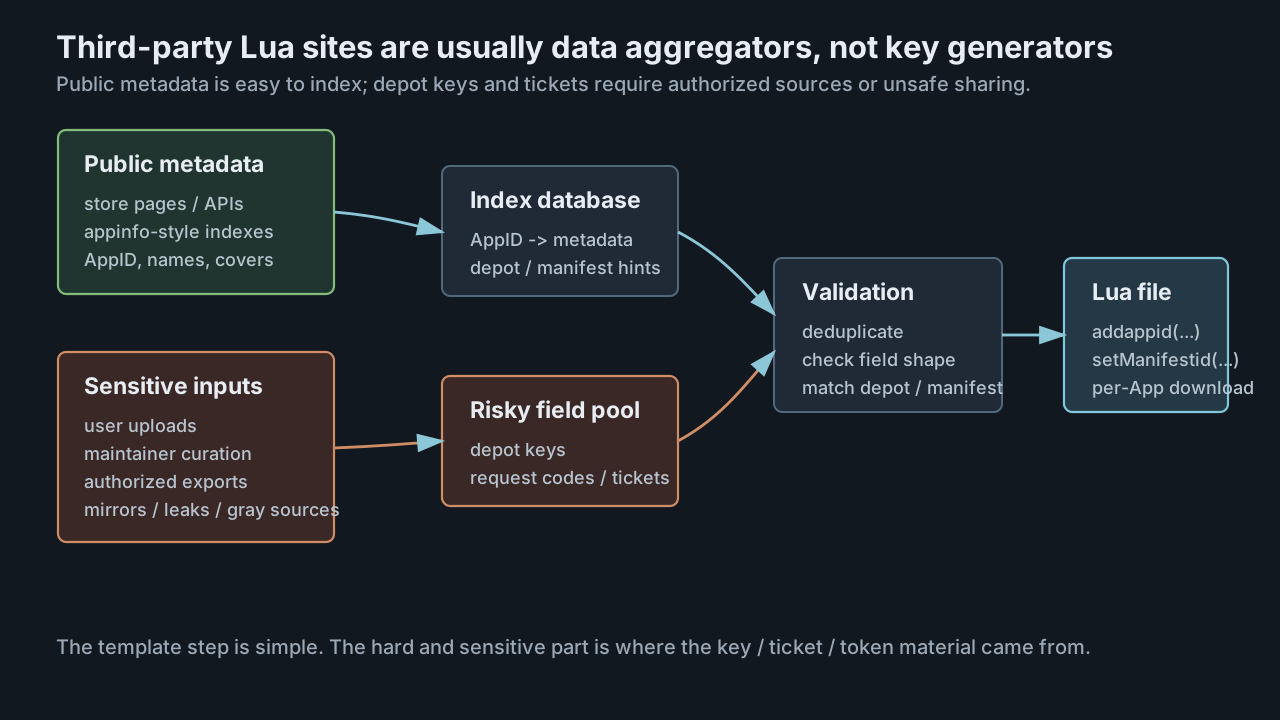
The difficult part is sensitive material. Depot keys, manifest request codes, AppTickets, ETickets, and access tokens should not be treated as public data. If a site can provide many working Lua files, the core source is unlikely to be computation. More likely inputs include user-uploaded Lua files, maintainer-curated lists, mirrored community repositories, exports from authorized clients or Steamworks-permissioned environments, or unofficial sharing and leaks. Neither the OpenSteamTool source nor the Steam content model supports deriving a depot key from AppID, DepotID, and manifest GID alone.
The final Lua generation step is comparatively mechanical: write the main app as addappid(main_appid), write keyed depots as addappid(depotid, placeholder, key), write manifest bindings as setManifestid(depotid, manifest_gid), and package the result as a .lua file for that AppID. In other words, the “download Lua” button does not necessarily hide complex reverse engineering. The hard problems are data provenance, consistency validation, and the compliance boundary around sensitive fields.
For technical analysis, these sites show how Lua lists circulate in the ecosystem. They should not be treated as authoritative sources. Once a Lua file contains real depot keys, it has crossed from ordinary metadata into permission-sensitive material.
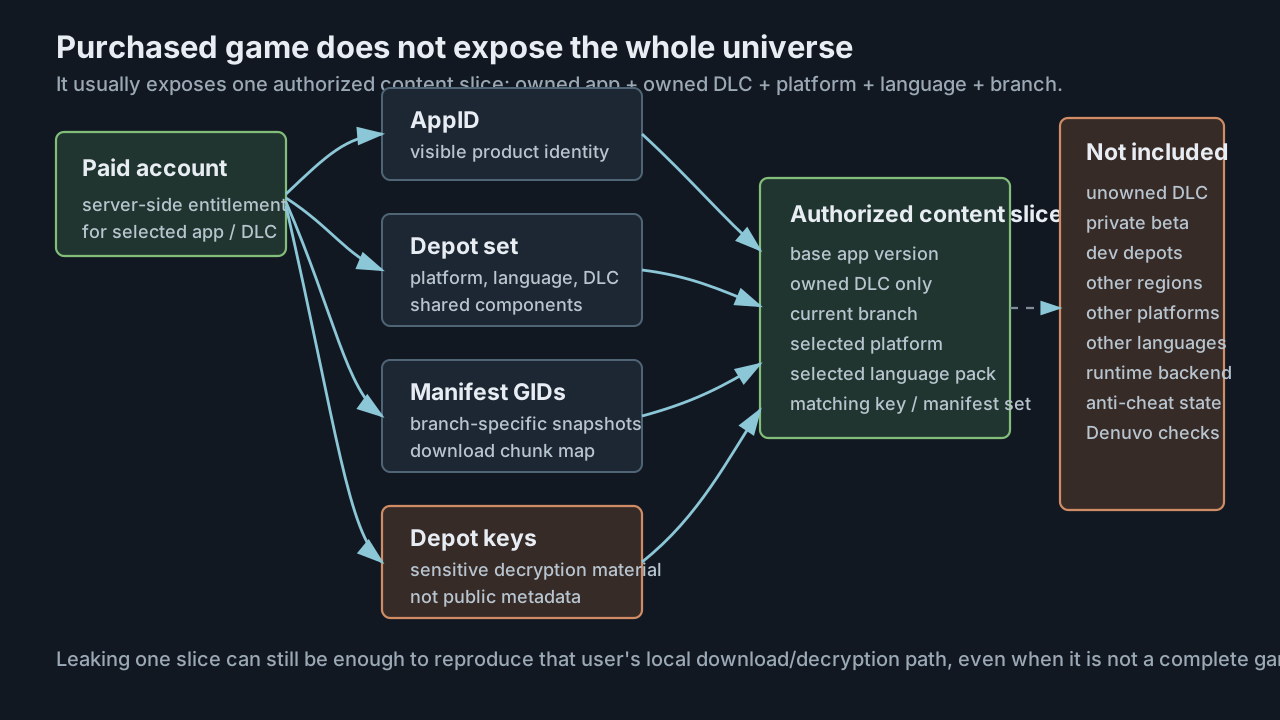
The risk can be stated more precisely. An ordinary paying user usually cannot obtain the whole universe of a game, but that user may obtain enough data to reproduce the specific content slice they are authorized to access. A content slice means the base app, owned DLC, platform depots, language depots, current branch, and manifest snapshots that the client actually downloads. To install and decrypt that slice locally, the client necessarily touches matching download metadata and decryption material.
If those materials are serialized into a Lua file that OpenSteamTool can consume, another client without the same entitlement may be pushed into a similar local path: the app appears in the library, install logic selects the same depots and manifests, the downloaded files match or closely match the paying user’s local version, and depot decryption succeeds locally. In other words, the sensitive part is not just a list of game IDs; it is a set of client-side materials sufficient to reproduce one authorized user’s content version.
That is the real sensitivity of these Lua lists. They may not cover every DLC, language, platform, historical manifest, or runtime authorization check. But if they cover the depot / manifest / key set for content a paying user actually downloaded, they may be sufficient for someone else to pirate that same content slice through a fake local library path. Whether the game then launches, works online, passes anti-cheat, passes Denuvo, or satisfies the game’s own backend depends on later server-side and runtime checks.
Loading and Hook Installation
OpenSteamTool ships proxy DLLs such as dwmapi.dll and xinput1_4.dll. They rely on Windows DLL search behavior so that steam.exe loads the local proxy first. The proxy then loads OpenSteamTool.dll; the XInput proxy also forwards real XInput exports to avoid breaking normal controller behavior.
OpenSteamTool.dll starts a worker thread. That thread:
- Gets the Steam installation directory.
- Copies
steamclient64.dlltobin\diversion.dll. - Loads
diversion.dll. - Reads
opensteamtool.toml. - Parses Lua directories.
- Starts the Lua file watcher.
- Installs SteamUI and SteamClient hooks.
The diversion.dll copy is important. Hooks_SteamUI.cpp intercepts Steam’s LoadModuleWithPath and returns the loaded diversion.dll module when Steam asks for steamclient64.dll. This gives OpenSteamTool a controlled hook surface.
LuaConfig as the Data Plane
LuaConfig.cpp converts Lua calls into C++ maps. One implementation detail matters: DepotKeySet is used both as the set of IDs considered by ownership/package hooks and as the map from depot IDs to depot keys. This is an implementation-level ID mixing, not a clean model-level separation between AppID and DepotID.
| Lua API | Runtime storage | Consumer |
|---|---|---|
addappid(id) | DepotKeySet[id] = "" | package, ownership, IPC, network hooks |
addappid(id, _, key) | DepotKeySet[id] = key | depot key hook |
setManifestid(depot, gid) | ManifestOverrides[depot] = { gid, 0 } | manifest hook |
addtoken(app, token) | AccessTokenSet[app] | PICS hook |
setAppTicket(app, hex) | registry AppTicket | IPC ticket handlers |
setETicket(app, hex) | registry ETicket | IPC ticket handlers |
setStat(app, steamid) | StatSteamIdSet[app] | UserStats hooks |
Lua parsing is line-oriented: ParseFile accumulates text until luaL_loadstring says it is a complete statement, then executes it. This is why one declaration per line works naturally.
Function names are case-insensitive. C++ registers lowercase helpers and installs a _G.__index fallback that lowercases unresolved global names.
Hot reload only handles newly added .lua files. Deleting or editing an existing file does not revoke already injected state in the current Steam session.
Package and Ownership Hooks
The first visible effect comes from Hooks_Package.cpp.
LoadPackage calls the original function, then, if PackageId == 0, appends all IDs from LuaConfig::GetAllDepotIds() into the package’s AppIdVec. This means all keys from DepotKeySet are appended; the project does not distinguish main AppIDs, DLC AppIDs, and DepotIDs at this stage.
CheckAppOwnership is even more direct. If the original function succeeds and pOwn->ExistInPackageNums > 1, OpenSteamTool marks the app as truly owned and excludes it from spoofing. Otherwise, if the queried app is in LuaConfig::HasDepot(appId), OpenSteamTool writes:
pOwn->PackageId    = 0;
pOwn->ReleaseState = Released;
pOwn->GameIDType   = App;
return true;
This is the local library illusion. Steam client callers receive an ownership result that looks valid enough to proceed.
Manifest and Download Path
Once the app looks owned, the install path still needs depot manifests.
BuildDepotDependency builds a vector of DepotEntry structures. OpenSteamTool walks that vector and, for matching depots, replaces ManifestGid with the value from ManifestOverrides.
setManifestid(depot, gid) therefore means:
When Steam builds the depot list, use this manifest GID for this depot.It does not mean “grant ownership” or “decrypt content.” It selects a content snapshot. There is also an implementation/documentation mismatch here: the README shows an explicit size argument example, but the current lua_setManifestid implementation forces size to 0 even if a third argument is supplied.
Some protected manifests also need a manifest request code. OpenSteamTool handles ContentServerDirectory.GetManifestRequestCode#1 at the protobuf packet layer. On request, it records the job ID and launches an async code lookup; on response, it injects the code and marks the result OK.
The provider order is:
- Lua
fetch_manifest_code_ex(app, depot, gid). - Lua
fetch_manifest_code(gid). - The configured provider branch, where the code has both
SteamRunandWudrm.
The analyzed Lua file stores GIDs, not request codes. Codes are resolved at runtime.
There is another implementation/documentation mismatch: Config.h defaults manifestUrl to Wudrm, and Config::Load only explicitly handles the string "wudrm". The FetchSteamRun branch exists, but the example url = "steamrun" is not explicitly parsed into ManifestUrl::SteamRun by the current code path.
Depot Decryption Keys
Hooks_Decryption.cpp intercepts LoadDepotDecryptionKey. When Steam asks for a key name ending in \<DepotId>\DecryptionKey, OpenSteamTool extracts the depot ID and asks LuaConfig::GetDecryptionKey(depotId).
If the Lua entry provided a non-empty 64-character key string, it is converted into 32 bytes and copied into Steam’s buffer. The registration path checks length, not full hexadecimal validity; conversion happens later with base-16 parsing semantics.
This is why the key strings matter:
Ownership makes the app look available.
Manifest GID chooses the depot snapshot.
Depot key makes encrypted depot content locally readable.
Missing any one of these can break the chain at a different stage.
IPC and Protobuf Hooks
OpenSteamTool also patches runtime-facing Steam API behavior.
At the IPC layer, IPCProcessMessage dispatches selected IClientUser and IClientUtils calls. Handlers can patch GetAppID, GetSteamID, app ownership ticket data, and encrypted app ticket calls. These paths are relevant to SteamStub, Denuvo, or games that ask Steam APIs about identity and ownership.
The active ETicket path is primarily IPC-based. The old Hooks_AppTicket::Install() path is commented out in HookManager.cpp, and the network-packet CMsgClientRequestEncryptedAppTicketResponse branch is also commented as migrated to IPC. The IPC flow is: record hAsyncCall -> appId in RequestEncryptedAppTicket, write cached ticket bytes in GetEncryptedAppTicket, and patch EncryptedAppTicketResponse_t to OK when GetAPICallResult is queried.
At the protobuf network layer, Hooks_NetPacket.cpp intercepts outgoing and incoming frames. It handles PICS access tokens, user stats, manifest request codes, family sharing notifications, and online-fix metadata. This layer is conditional, not global: PICS injection only touches existing app entries that match both HasDepot and a configured access token; UserStats spoofing avoids requests with sha_schema, tracks job IDs, and has separate schema-version conditions for ClientGetUserStats. This layer is necessary because not every meaningful Steam result is a synchronous local function return; many are asynchronous service responses.
1086940.lua does not configure tickets or tokens, so its main role is library/download/decryption. The project as a whole is broader than that one file.
End-to-End Chain for 1086940.lua
The chain is:
- Steam loads a proxy DLL.
- The proxy loads
OpenSteamTool.dll. - OpenSteamTool loads a hooked copy of
steamclient64.dll. - Lua files are parsed.
addappidfillsDepotKeySet.setManifestidfillsManifestOverrides.LoadPackageinjects IDs into package 0.CheckAppOwnershipreturns an owned/released result for configured IDs.- Steam UI and install logic see the app as locally available.
BuildDepotDependencyreplaces manifest GIDs for configured depots.- The manifest request-code hook patches protected manifest responses when needed.
LoadDepotDecryptionKeysupplies key bytes from Lua.- IPC and network hooks patch selected runtime API behavior.
That is the technical meaning of “fake library entry” in this project.
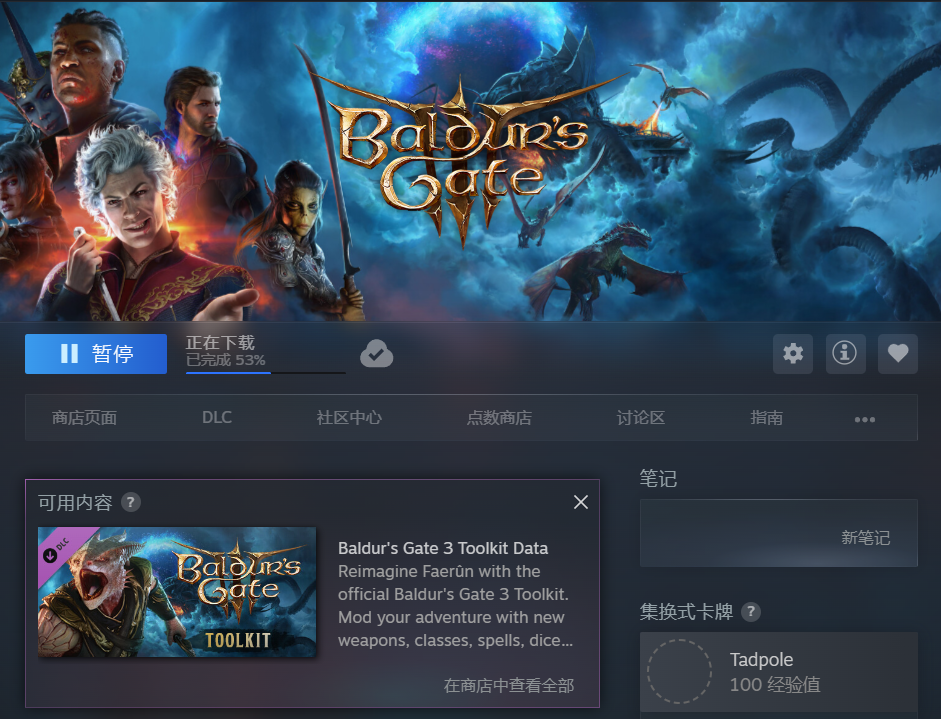
The visible client-side result can look like an installable or downloading Steam library page. The screenshot below demonstrates that local path. It proves that the client state reached the install/download branch; it does not prove that the account has a real server-side entitlement.
Building a Research Lua Without a Ready-Made File
If there is no ready-made Lua file, a usable file cannot be generated from nothing. OpenSteamTool’s Lua is not a cracker or a discovery engine. It only serializes already known App, depot, manifest, key, token, or ticket material into a format consumed by the C++ hooks.
In an authorized research environment, the workflow is:
- Define the target boundary: use an app you own, develop, or have explicit permission to test. A public AppID identifies the target but grants no content rights.
- Map AppID to depots: use Steamworks, SteamPipe build output, authorized client metadata, or appinfo-style indexes to understand the main AppID, DLC AppIDs, platform depots, language depots, and shared depots.
- Select manifest snapshots: choose a manifest GID for each depot that must participate in the download path. The GID is a depot-version selector, not an entitlement.
- Obtain authorized decryption material: depot keys must come from a path allowed to access that depot. They are not derivable from manifest IDs and cannot be replaced by random 64-character strings.
- Identify extra gates: protected manifests may need request codes; runtime paths may need AppTicket or ETicket data; protected metadata may need PICS access tokens.
- Write Lua according to source semantics: the key must be the third
addappidargument, and the currentsetManifestidimplementation does not preserve the optional size argument. - Validate consistency: verify that every key belongs to the depot ID it is attached to, every manifest belongs to the selected depot and branch, and AppIDs and DepotIDs are not accidentally conflated even though OpenSteamTool stores them in the same internal map.
A structural, non-real example looks like this:
-- Main app: put it into the ownership candidate set.
addappid(1000000)

-- Content depot: the third argument is the authorized 32-byte key encoded as 64 chars.
-- The second argument is not used by the current OpenSteamTool source.
addappid(1000001, 1, "AUTHORIZED_DEPOT_KEY_64_HEX_PLACEHOLDER")
setManifestid(1000001, "1111111111111111111")

-- Optional DLC or additional depot, depending on appinfo and dependency metadata.
addappid(1000002, 1, "AUTHORIZED_EXTRA_DEPOT_KEY_64_HEX_PLACEHOLDER")
setManifestid(1000002, "3333333333333333333")

-- Protected manifest providers are intentionally left as non-operational placeholders.
function fetch_manifest_code_ex(appid, depotid, manifestid)
    return 0
end
The key placeholders above are intentionally not 64-character hex strings accepted by the current source; the manifest placeholders also do not correspond to real content. They describe shape, not reusable data. A working research sample requires correct ID relationships, manifest-to-depot matching, authorized depot keys, and lawful request-code, ticket, or token handling where those paths are needed. Otherwise the failure will show up as a visible-but-not-installable app, failed manifest retrieval, failed decryption, or runtime rejection by Steam API or the game’s own backend.
Capability Boundaries and Likely Tooling
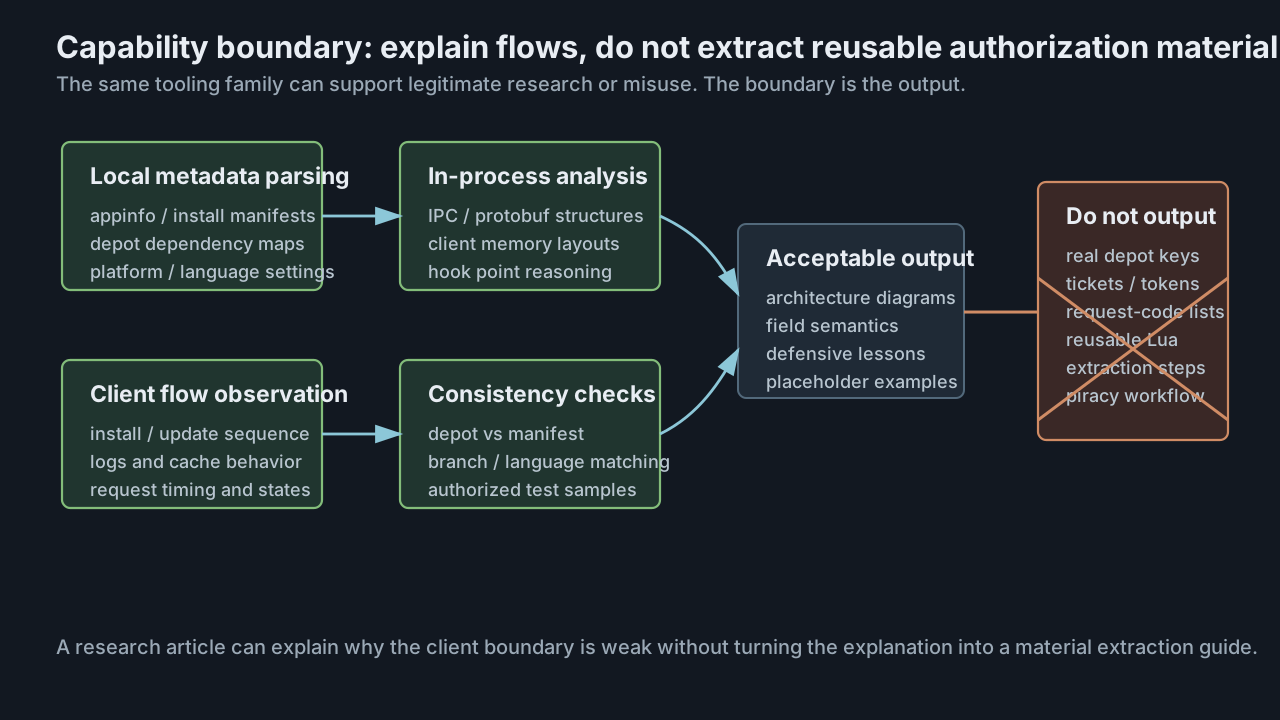
From a purely technical angle, a researcher who has a local Steam client and legitimately purchased games can study which metadata and intermediate materials the client touches in order to install and run those authorized contents. That research should stay at the level of data flow, trust boundaries, and defensive design. It should not export, redistribute, or reuse depot keys, tickets, tokens, or other authorization and decryption materials, and it should not produce Lua files intended for unauthorized fake-library use.
At a high level, the relevant tooling areas are:
| Research area | Possible observation target | Question answered | Boundary |
|---|---|---|---|
| Local metadata parsing | appinfo, library metadata, install manifests, depot dependency data, language / platform settings | How AppIDs, DepotIDs, manifest GIDs, branches, and language packs relate | Analyze structure, do not redistribute sensitive fields |
| Download-flow observation | install / update flow, manifest requests, content-server interaction, logs and caches | When the client needs manifests, request codes, and depot keys | Do not capture or reuse material that decrypts real content |
| In-process reversing and hooks | steam.exe, steamclient64.dll, IPC, protobuf, memory structures | Why OpenSteamTool-style tools can rewrite the client view | Do not provide practical key / ticket extraction steps |
| Cache and registry auditing | Steam local config, registry state, ticket caches, runtime state | Which states are cached locally and which may be consumed by games | Do not export identity or ownership tickets |
| Consistency validation | depot-to-key, manifest-to-branch, language-pack-to-platform relationships | Why mismatched list fields break download or decryption | Validate only authorized or placeholder samples |
In other words, these capabilities can explain why a Lua file works, why it fails, and which authorized content slice it appears to describe. They should not be used to extract reusable materials from a real purchased game and hand them to other users. That would move from client trust-boundary research into authorization bypass and piracy distribution risk.
Limits and Failure Modes
The design is powerful but fragile.
It depends on byte signatures in Patterns.h. Steam client updates can move or rewrite internal functions.
It depends on local definitions of Valve internal structures such as PackageInfo, AppOwnership, DepotEntry, and CUtlBuffer. These layouts are not stable public ABI.
It is additive within a session. Newly added Lua files can refresh state, but removing or editing existing files does not cleanly revoke prior injections.
It is incomplete against server-side checks. Game backend authorization, multiplayer services, anti-cheat, cloud saves, Denuvo, encrypted tickets, and account risk systems may still reject the session.
It involves sensitive materials. Depot keys, tickets, and access tokens should not be redistributed as if they were ordinary configuration.
Conclusion
1086940.lua stores content metadata, not executable bypass logic. It declares which IDs should be treated as relevant, which manifest snapshots should be selected, and which depot keys should be returned when Steam asks for them. OpenSteamTool’s C++ layer turns those declarations into local Steam client behavior by patching package, ownership, manifest, decryption, IPC, and protobuf paths.
The broader lesson is about client trust boundaries. A rich desktop client must cache and transform server facts into local structures. If an in-process actor can modify those structures before they are consumed, the client can be made to believe a different local reality. Strong authorization must therefore close the loop at the server, ticket, key-distribution, and runtime-verification layers.
This article is for technical discussion, source reading, and client trust-boundary research only. It should not be used to bypass purchases, authorization, or platform rules. Steam and OpenSteamTool both change over time; if any source interpretation or terminology here is wrong, corrections are welcome.